How to Choose the Right Colours for Animals Using Coloured Pencils
How to Choose the Right Colours for Animals Using Coloured Pencils
This is one of the most common questions I’m asked by students who are learning to draw animals with coloured pencils, and it’s also one of the most complex. Choosing colours that create lifelike, realistic results takes time, practice, and an understanding of how colour behaves in layers.
I’ve created a video that explains my approach in detail, specifically for animal subjects. It includes practical tips for colour selection and techniques to help you build confidence and colour knowledge. You can watch the 13-minute video here: How to Choose the Right Colours for Animals Using Coloured Pencils
Why colour selection can be challenging
Coloured pencils present unique challenges because there are so many variables involved: the brand of pencils you use, the pressure you apply, the surface you draw on, and even how your eye perceives colour. The sequence in which you apply colours also has a significant impact on the final result.
Start small and build your palette gradually
One of the best ways to develop your colour sense is to work on small studies or simple animal subjects using a limited palette. I recommend doing a few studies with the three primaries of blue, red and yellow. It is amazing how many beautiful colours you can mix with these three colours, along with light pressure on white paper for lighter variations.

Focus on mastering a few colours first, and once you’re confident, gradually introduce more. Always test colour combinations on scrap paper before applying them to your artwork, this helps ensure your mixes will layer and blend the way you intend.
The pressure you use and the order in which you apply colours will affect both the richness and the temperature of the final tone. Light, layered applications generally produce more luminous results, while heavy pressure tends to flatten the colour.
Understanding base colours and light
When choosing your base colour, think about both the value (lightness or darkness) and the temperature (warm or cool quality) of the final colour you want to achieve.
For example, when drawing black fur, first determine whether the black is in light or shade.
If it’s in the light, start with lighter tones such as blue-grey, violet, or soft blue for highlights.
If it’s in shadow, observe whether the black leans warm or cool.
A warm black might have reddish or brown undertones, so start with warm browns like Caput Mortuum or Burnt Siena.
A cool black might benefit from a base of deep blue or violet, layered with black to build depth.
Working with other colours
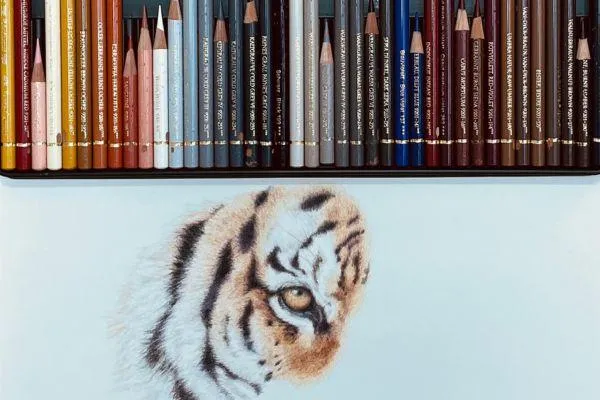
Take orange for example, like the body colour of a tiger. The colour wheel is your best guide. If your subject’s fur is close to orange, start by identifying those orange-based pencils in your set. Then ask: is the fur lighter or darker, warmer or cooler?
For lighter areas, use warm greys as an under layer, light yellows or ivory to lighten
For darker areas, shift towards cooler, deeper tones such as Caput Mortuum Violet, Burnt Umber, or Burnt Sienna.
Every animal, and every lighting situation, is unique. There’s no fixed formula for colour mixing; observation and experimentation are key.

Constantly evaluate your progress
As you layer colours, continually ask yourself:
Is the value correct? Does it need to be lighter or darker?
Is the temperature right? Does it need to be warmer or cooler?
Do I need more layers to achieve the correct depth and realism?
Developing your eye for colour takes time, but with patient observation and practice, you’ll begin to see subtle shifts and understand how to recreate them with your pencils.
Choosing colours is a skill built through experience. The more you experiment, the more natural it becomes, and soon, you’ll instinctively reach for the perfect combination to bring your animal drawings to life.
If you would like to learn more on selecting colours for animal drawings, I have a created a course called: How to feel confident mixing and blending coloured pencils that I created to help with colour selection. The course is A$27.